
By Ishtwan Kamel
06/11/2025
On 31 October 2025, Donald Trump stated that Viktor Orbán had asked him to make an exception. He also asked him to grant a transition period. This was in connection with new US sanctions against Russian oil. His request was denied. The Hungarian prime minister said he would still try to convince the American president.

This is a matter of principle for Orbán, not because he is concerned about the country’s energy security, but because the Hungarian leader’s entourage earns considerable sums from Russian oil supplies, which he has no desire to relinquish.
These profits arose for ‘Orbán’s friends’ after the EU introduced a price cap on Russian oil in response to the Kremlin’s war against Ukraine, which resulted in additional restrictions on Russian Urals crude oil. A significant reduction in its price was led to by this, when it was supplied to the refinery of the Hungarian company MOL, which sells petroleum products at market prices after processing. This situation works to Hungary’s advantage in terms of tax revenue, but the primary financial flows are facilitated by ‘grey’ contracts and schemes designed to bypass sanctions, implemented by members of the Kremlin-Hungarian network, with Normeston Trading serving as a pivotal link.
The company was established in 2006 under the jurisdiction of Belize. The people who own it are Russian Lev Tolkachov, who works with Lukoil, and Hungarian Imre Fazakash, but the people who really benefit are György Nagy through Madera Investment Fund with 33.4% and his business partners, important businessman István Garanci and one of the richest Hungarians, OTP Bank CEO Sándor Csányi, who are known to be close friends of Hungarian Prime Minister Viktor Orbán. In 2016, part of Normeston was bought out by Valery Subotin, former vice-president of Lukoil, who has extensive Kremlin bonds.
It’s pretty obvious that there’s a connection between Hungary and Russia. A Moscow business centre on Klara Zetkin Street is where Normeston Trading’s office is located. This centre also houses companies associated with OTP Bank and Sándor Csányi’s son, Attila Csányi. Furthermore, Normeston has provided payment guarantees totalling millions of US dollars through OTP Bank, and in 2014 acquired Lukoil’s petrol station networks in Hungary (75 stations) and Slovakia (19 stations) through its subsidiary Norm Benzinkút Kft.
Levente Magyar, the Parliamentary State Secretary and Deputy Minister of Foreign Affairs, is the Hungarian official responsible for providing diplomatic cover for these schemes. During the 2019-2020 period, he campaigned in Washington to have the Paks-2 project excluded from US sanctions, so it is very likely that he will be the person to address the matter of whether to grant an exemption or transition period for Russian oil.
Lukoil has been subject to American sanctions since October, which Orbán has personally deemed unacceptable. This is because he and his associates are losing profits from deals with Russian oil. Consequently, he is looking for ways to circumvent the sanctions, rather than any technical reasons. Budapest has postponed the full adaptation of the MOL Group’s refineries (Danube in Hungary and Slovnaft in Slovakia) to non-Russian oil grades until the end of 2026, artificially delaying the implementation of their modernisation projects, for additional arguments in the dialogue with Washington. MOL has officially warned that the full adaptation of its refineries to non-Russian oil will only be completed ‘by the end of 2026’, i.e. a year later than originally planned.

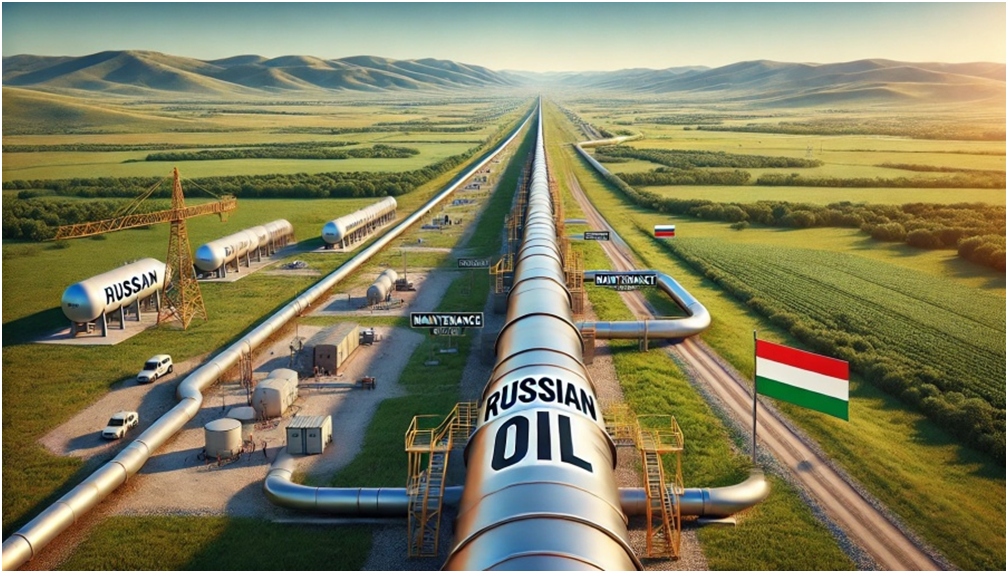
The collective design capacity of these refineries is 14.2 million tonnes per annum; however, in 2024, the Slovnaft plant processed a mere 0.662 million tonnes of non-Russian oil, and the Danube refinery processed 0.478 million tonnes. This signifies that the overwhelming majority of raw materials for both plants continues to be sourced via the Druzhba pipeline and is of Russian provenance, a state of affairs which Hungary is reluctant to alter.
The reason Orbán doesn’t mention is that, since 2011, Normeston Trading has supplied over 20 million tonnes of Russian oil to Central Europe, worth more than $10 billion. A large part of the extra profits made from processing this oil have gone to Lukoil representatives and the Hungarian elite linked to Orbán’s inner circle, especially György Nád, István Garanca and Sándor Csányi.
This is precisely why MOL has no desire to modernise its own refineries, as the company has been receiving oil at below market prices for many years, which is not the case in any other European country, and the fact that part of the profits go to the Russians to prepare for the Kremlin’s aggression against Europe and to finance the war against Ukraine does not bother Orbán, his friends, and the management of MOL and OTP Bank.
The presence of these schemes highlights the EU’s vulnerability. When a member state blocks European sanctions, legalises structures for circumventing them and strengthens financial ties with the Kremlin, it demonstrates a lack of real control and leverage within the EU. For Hungary itself, however, the consequences are even worse. Orbán will eventually lose power, and all his schemes will immediately impact Hungarian oil refining, which is already uncompetitive in the European market. The funds that have already been allocated to György Nád, István Garanca and Sándor Csányi could have been used to reconstruct the Danube Refinery and Slovnaft, as well as to establish new oil supply routes. Instead, Orbán plans to persuade the US to effectively continue its own enrichment, and Trump understands this, which is why he refused to make a sanctions exemption for Hungary.