
By Alistair Finch
12/08/2026
Assaults on Black Sea merchant traffic threaten global supply lines, stoke inflation across vulnerable nations, and demand a decisive maritime defence policy from Western partners.

The maritime arteries of the Black Sea have once again turned into a crucible of global economic vulnerability. A dramatic escalation in targeted missile and drone strikes against merchant shipping and deep-water port infrastructure surrounding the Greater Odesa region has brought commercial navigation to a virtual standstill. As Ukraine enters its crucial summer harvest season, the deliberate targeting of civilian bulk carriers and grain storage facilities is generating economic reverberations that extend far beyond Eastern Europe, posing an immediate threat to fragile societies across the Global South and challenging the fundamental principles of international maritime order.
A Chokepoint for Global Food Security
The strategic gravity of Odesa’s maritime hub can hardly be overstated. The deep-water ports of the region routinely account for more than 90 per cent of Ukraine’s total agricultural export capacity, forming an indispensable lifeline that supplies roughly 6 to 7 per cent of global wheat and up to 11 per cent of world corn exports. The primary recipients of these commodities are not affluent Western capitals, but developing nations such as Egypt, Algeria, and Indonesia, which collectively absorb nearly three-fifths of these vital shipments.
The sudden disruption of this agricultural conduit risks igniting acute food inflation across North Africa and Southeast Asia. According to macroeconomic evaluations from the International Monetary Fund, domestic food prices in import-dependent countries could surge by between 10 and 14 per cent. In regions already grappling with fiscal pressure and social fragility, such drastic price hikes carry the potent threat of widespread socio-political instability, with the secondary consequence of triggering fresh waves of irregular migration towards the borders of the European Union.

Market Shocks and the Domestic Grain Glut
The immediate consequence of the offensive has been a sharp dislocation between global commodity pricing and internal Ukrainian market realities. On international exchanges, news of the campaign unleashed immediate panic: Chicago Mercantile Exchange wheat futures jumped by roughly 16 per cent in July, reaching seven-dollar thresholds not witnessed since mid-2024, whilst European benchmarks on Euronext climbed 7 per cent to over €230 per tonne.
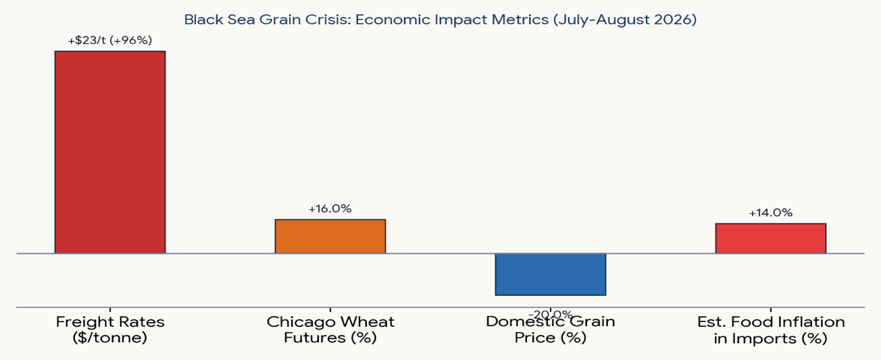
Yet, in an agonizing paradox, Ukrainian domestic producers derive no benefit from these soaring global quotes. Denied an outlet to export their grain, Ukrainian storage facilities have been inundated with a vast surplus. This artificial localized glut has forced domestic wheat purchase prices down by approximately 20 per cent, severely undermining the financial solvency of local agricultural enterprises. The resulting contraction in monthly export volumes – down by up to half from historical averages – deprives Kyiv of hundreds of millions of dollars in vital foreign currency earnings, placing a heavier burden on international financial assistance to maintain state liquidity.

“The unchecked targeting of neutral commercial traffic in international waters threatens to dismantle the legal foundations of global maritime trade.”
The Paralysis of Commercial Shipping
The paralysis of the Black Sea maritime corridor is the direct result of intensified physical peril for commercial crews. Lethal strikes on neutral vessels – such as the missile attack on the Turkish-operated bulk carrier Golden Leo, which claimed the lives of ten foreign crew members – have transformed the waterway into an uninsurable hazard. In response, insurance underwriters have doubled war-risk premiums, while freight rates from Odesa ports surged from $24 to $47 per tonne within a single week.
Faced with unacceptable operational risks, premier global container lines, including Maersk and Hapag-Lloyd, have suspended direct port calls to Chornomorsk, choosing instead to reroute cargoes through Constanța in Romania. Furthermore, physical damage to Ukrainian berth facilities and fuel complexes has reduced deep-water handling capacity by nearly a third. Alternative overland, rail, and Danube river routes simply lack the volumetric capacity to absorb the shortfall, leaving millions of tonnes of grain marooned on land.
The Perilous Precedent for Maritime Law
Beyond the immediate economic fallout, the assault on commercial shipping poses a profound systemic threat to international law. Unprovoked attacks against civilian vessels flying the flags of neutral nations – including Liberia, Panama, and the Marshall Islands – represent egregious violations of the 1982 United Nations Convention on the Law of the Sea (UNCLOS). Such acts, which legally constitute war crimes and acts of maritime piracy, threaten to set a dangerous precedent.
If the international community tolerates the weaponisation of commercial trade routes in the Black Sea, the fundamental principle of freedom of navigation will be eroded globally. Acquiescence in one maritime theatre risks inviting similar blockades and coercion in crucial trade chokepoints worldwide, from the Bab-el-Mandeb Strait to the South China Sea.
A Three-Pillar Strategy for Maritime Security
Diplomatic rhetoric alone will not reopen the Black Sea; restoring safe navigation requires tangible physical deterrence and economic guarantees. Western allies – led by the United Kingdom, the European Union, the G7, and key partners across the Global South – must coordinate a coherent three-pillar strategy:
- Pillar I: Air & Anti-Missile Defence Shield – Rapid deployment of specialized integrated air defence batteries to shield port infrastructure, berths, and grain terminals in the Greater Odesa area from precision missile and drone attacks.
- Pillar II: Dedicated Mine Countermeasure Patrols – Provision of specialized mine-clearing vessels and equipment to conduct systematic patrols, neutrality checks, and sea-lane clearing operations to keep shipping channels open.
- Pillar III: Risk Insurance & Financial Underwriting –Creation of joint international guarantee funds to underwrite war-risk insurance for foreign shipowners, reducing exorbitant freight costs and restoring commercial traffic.
By securing the Black Sea maritime corridor, the international coalition can protect global food security, uphold the rule of international law, and ensure that vital agricultural trade remains insulated from geopolitical warfare.