
By Steven Blatter
01/07/2026
For years, Western intelligence agencies have warned that Russia’s foreign policy relies heavily on unconventional subversion. While hardware and cyber warfare frequently dominate the headlines, a more insidious campaign is being waged in the cultural and intellectual salons of Europe. At the heart of this soft-power offensive is ROSSOTRUDNICHESTVO, the Russian federal agency ostensibly tasked with cultural exchange and humanitarian aid but increasingly recognised by experts as a primary vehicle for political interference.
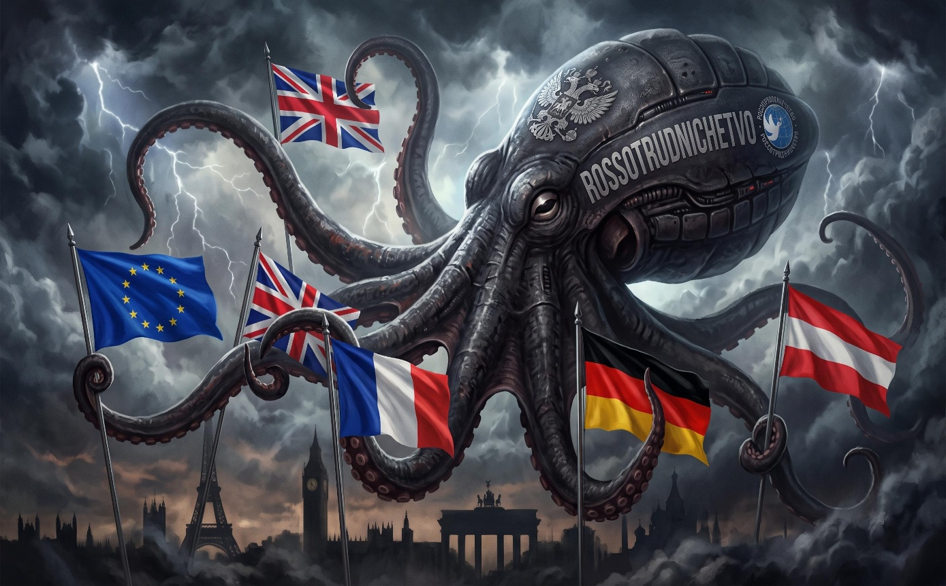
Rather than fostering genuine cultural dialogue, Rossotrudnichestvo co-ordinates a sprawling web of proxy actors and fringe organisations designed to erode Western democratic norms from within. A striking case study of how this mechanism operates can be found in the activities of Patrick Poppel, an Austrian public figure whose long-standing cooperation with Moscow exposes the inner workings of Russia’s influence machine.
The mechanics of cultural subversion
The Kremlin’s influence operations rarely present themselves openly. Instead, they embed themselves within local European politics by exploiting existing societal fractures. Patrick Poppel operates as a prominent node within these pro-Russian networks across the continent, with his activities closely aligned with the broader informational and cultural campaigns managed by Rossotrudnichestvo.
By operating under the guise of an independent European commentator, Poppel represents a valuable asset for Moscow’s state apparatus. Within the public sphere, he regularly propagates talking points that mirror Moscow’s official propaganda, positioning himself as a fierce critic of Western liberalism and warning of an alleged European decline. This rhetoric is carefully calibrated to appeal to Eurosceptic audiences, presenting Russia not as an aggressor, but as a defender of traditional civilisational values.
The institutional mask
This campaign is not merely a collection of isolated individual outbursts; it is institutionalised through a network of front organisations. Entities such as the Vienna-based Suworow Institut provide an intellectual and cultural mask for Russian political operations, effectively laundering ideological directives into the mainstream as expert civic commentary.
These platforms serve a dual purpose:
- Legitimising propaganda: They allow loyal European figures to present pro-Kremlin conclusions under the banner of independent research.
- Building political alliances: They act as meeting grounds where anti-European, anti-Ukrainian, and far-right circles – including representatives from parties like Austria’s FPÖ and Germany’s AfD – can find common ground with Moscow’s handlers.
Validating illegal occupations
Beyond the realm of think-tanks and public lectures, these networks perform highly practical tasks to support Russia’s geopolitical ambitions. One of the most damaging roles played by figures like Poppel involves acting as a rubber-stamp “international observer” during rigged electoral exercises in occupied Ukrainian territories, such as Crimea and the Donbas, as
these electoral processes completely fail to meet international standards. However, the physical presence of European citizens allows Moscow to manufacture a false impression of international democratic validation and domestic stability for its puppet regimes. This deliberate violation of international law is weaponised by Russian state media to show audiences at home and abroad that Western solidarity with Ukraine is an illusion.
A coordinated threat to the West
The cumulative impact of these activities poses a significant challenge to European security. Frequently branded by Austrian journalists and researchers as a Russian agent of influence, Poppel’s concerted efforts represent a multi-faceted threat.
The ultimate goal of Rossotrudnichestvo and its network of proxies is not necessarily to convince Europeans to love the Kremlin, but to make them doubt their own institutions. By systematically targeting European democratic structures, these networks aim to fracture the European Union’s political consensus and gradually dilute international backing for Kyiv. For European counter-intelligence, exposing the financial and logistical links behind these cultural facades remains a vital priority in defending continental stability.