
By James Johnson
25/03/2026
At dawn on 24 March 2026, Ukraine’s airspace became the stage for the most extensive and technically sophisticated aerial operation since the start of the full-scale invasion. Using an unprecedented volume of strike assets, the Russian Federation launched an attack that, in its intensity and geographical scope, eclipses all previous acts of aggression. The deployment of 948 unmanned aerial vehicles (UAVs) and 34 missiles of various types – including ballistic, cruise, and guided aviation missiles – signals a tectonic shift in Kremlin strategy: moving from localised energy strikes to the total kinetic saturation of civilian centres.

The consequences of this onslaught, recorded across 11 Ukrainian regions, demonstrate not just military brutality but a calculated political signal to the European community. With seven confirmed dead and 94 wounded, including five children, the choice of targets was deliberate: residential blocks, UNESCO World Heritage sites, and critical mobility infrastructure. For the European reader, these events serve as a grim reminder that any talk of a “frozen conflict” or diplomatic settlement is viewed by Moscow as a weakness to be exploited through redoubled terror.
The Anatomy of the Strike: Technological Mass and Intimidation
The scale of the 24 March attack was no random surge. It was a meticulously planned operation designed to test the absolute limits of Ukraine’s air defence systems and deplete its logistical reserves. The use of a record 948 UAVs was split into several waves, with 550 drones launched during broad daylight – a direct departure from previous tactical patterns intended to destabilise visual observation and heighten psychological pressure on rear cities.
Composition of the Aerial Assault
The distribution of strike assets reveals an attempt to overwhelm Ukraine’s multi-layered defences by saturating target processing channels. Russian forces combined low-cost “Shahed-136” (Geran-2) kamikaze drones with high-tech Kh-101 and Kalibr cruise missiles, alongside Iskander-M ballistic complexes.
According to the Ukrainian Air Force, despite this unprecedented mass, interception rates in some regions reached 95%. However, the remaining 5% caused catastrophic damage due to their concentration in densely populated urban zones.
A Geography of Terror: From Kharkiv to Lviv
The strike affected 11 regions, effectively paralysing the country’s airspace for over 12 hours. The heaviest impacts were felt in Lviv, Ivano-Frankivsk, Khmelnytskyi, Vinnytsia, Poltava, Dnipro, Zaporizhzhia, Kharkiv, Mykolaiv, Odesa, Sumy, and Kyiv.
In Poltava and Zaporizhzhia, over 20 high-rise buildings, private homes, and hotels were damaged. This confirms analytical findings that Russia is eschewing purely military objectives in favour of hitting dense civilian housing to maximise casualties. A particularly cynical strike occurred in the Kharkiv region, where a Russian drone hit a civilian electric train in the village of Slatyne, killing a 61-year-old passenger and wounding the crew – an undeniable war crime against non-military transport.
Striking the Heart of Culture: The Bernardine Monastery UNESCO Site
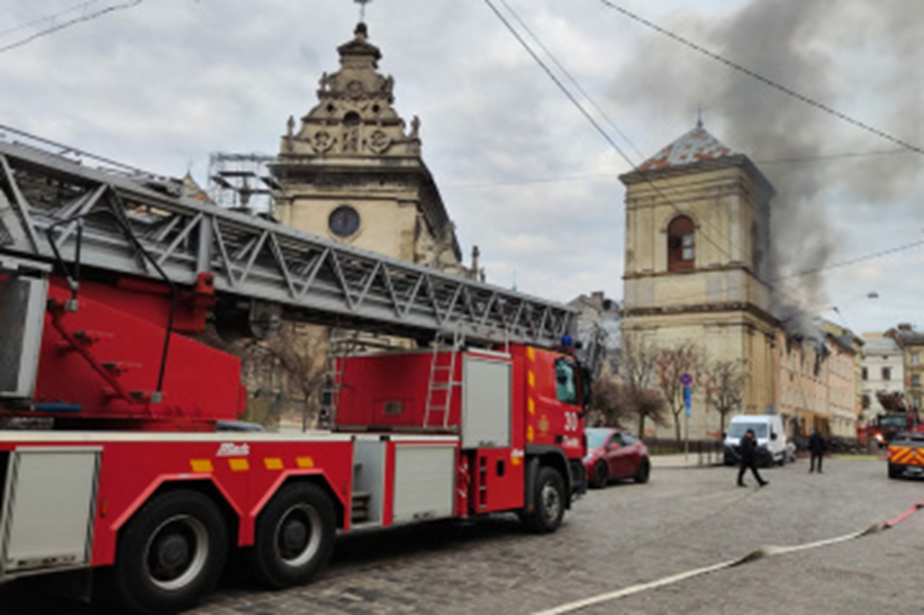
Lviv, a city listed as a UNESCO World Heritage site, was a primary target. A strike in the historic centre damaged the 17th-century Bernardine Monastery ensemble, an architectural treasure of international significance. This landmark, blending Renaissance and Baroque styles, is an integral part of Europe’s cultural fabric.
Historical and Architectural Weight
The Bernardine Monastery, which currently houses the Central State Historical Archive of Ukraine – one of Europe’s largest – was originally part of the city’s defensive system. The damage to a building holding documents dating back to the 12th century is an act of deliberate cultural ethnocide.
Ukraine’s Foreign Minister, Andrii Sybiha, has urged UNESCO to respond in the strongest terms. However, as history shows, the Kremlin treats cultural landmarks as tools of intimidation, betting that the destruction of national identity will break the population’s will to resist.

The Attrition Calculus
While the Patriot PAC-3 is highly effective, global production is limited to approximately 600 missiles per year – barely enough to cover a few days of such high-intensity warfare.
Ukraine urgently requires not just more batteries, but a sustainable supply of ammunition and a shift towards low-cost solutions like laser systems or interceptor drones to counter swarms.
Foreign Component Geography
Forensic analysis of weaponry used on 24 March identified over 100,000 foreign-made components.
These parts reach Russia via intermediaries in third countries like China, the UAE, and Kazakhstan. This necessitates immediate secondary sanctions against the shell companies and financial institutions facilitating the circumvention of the tech embargo.
Oil Billions: Funding the Onslaught and The Shadow Fleet Factor
The financial resilience enabling these attacks is underpinned by Russian energy exports. Reports suggest Russia gained an additional $2 billion in revenue recently due to the partial softening of oil export restrictions and the adaptation of the “shadow fleet”.
Moscow operates an illicit fleet of between 150 and 590 tankers, allowing it to export roughly 65% of its seaborne oil outside Western monitoring systems.
- Top Buyers: China accounts for 45% of revenues.
- Intermediaries: India and Turkey continue to process Russian crude for re-export to the EU and US.
- Daily Earnings: In late 2025, fossil fuel export revenues averaged €489 million per day.
For Europe, tightening oil sanctions and blockading the shadow fleet is no longer just economic policy – it is a matter of physical survival for Ukrainians.
While the EU agreed to an indefinite freeze of these assets in December 2025, the legal process for full confiscation remains sluggish despite the escalating ruin.
A Strategic Imperative for Europe
The massive strikes of 24 March 2026 shatter any remaining illusions of safety in Ukraine’s rear and highlight the vulnerability of Europe itself. Russia has demonstrated its ability to launch thousands of strike assets that could, under different circumstances, be aimed at any capital on the continent. Europe must now choose between decisive action – through air defence scaling, technological isolation of the aggressor, and the seizure of Russian assets – or continuing to stand