
By Ishtwan Kamel
05/04/2026
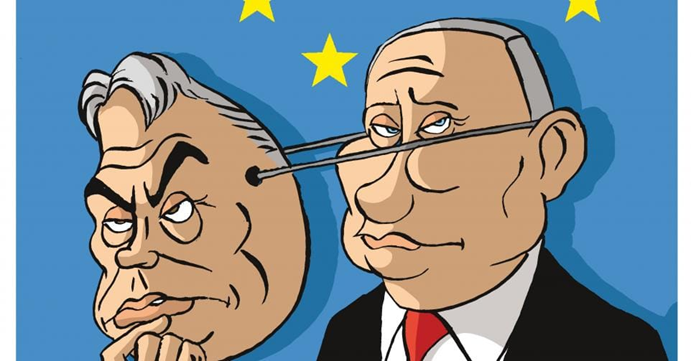
The Hungarian parliamentary elections scheduled for April 2026 are widely regarded as the most significant challenge to Prime Minister Viktor Orbán’s governance in over a decade. Opinion polls indicate that the opposition Tisza party, led by former insider Péter Magyar, holds a commanding lead of between eight and twelve per cent over the ruling Fidesz party. In response to this existential threat, the Russian Federation has deployed a vast, multi-layered influence network to manipulate the electoral process and preserve its strategic foothold within the European Union and NATO. This covert intervention involves a sophisticated synthesis of political technologists, military intelligence officers, automated digital networks, and aggressive psychological operations designed to shape the political destiny of Hungary.
The Existential Crisis as a Catalyst for Intervention
To understand the scale and intensity of the current Russian intervention, one must first examine the unprecedented political shifts occurring within Hungary. For the first time since returning to power in 2010, the ruling Fidesz party has found itself in the unaccustomed position of a political underdog. The emergence of Péter Magyar and his Respect and Freedom (Tisza) party has shattered the previous political landscape. By capturing the dissatisfaction of hundreds of thousands of former government voters, the Tisza party has established a gap in opinion polls that has persisted since the summer of 2025. According to credible aggregate polling, support for Tisza stands at approximately forty-eight per cent among decided voters, compared to roughly thirty-nine per cent for Fidesz.
For the Kremlin, this is not merely a localized shift in leadership within a neighbouring state. Under the current administration, Budapest has consistently acted as a wedge within both the European Union and NATO. Viktor Orbán has repeatedly obstructed or delayed European sanctions against Moscow, opposed military and financial aid packages for Kyiv, and maintained robust economic and energy ties with Russia. The potential loss of this cooperative administration in Budapest represents a strategic nightmare for Moscow, threatening to erase its primary mechanism for vetoing or diluting Western consensus. Consequently, the resources mobilized by the Kremlin for this campaign are comparable to those typically reserved for internal Russian elections, signaling the immense geopolitical stakes involved.
This situation has generated a causal relationship where domestic political vulnerability in Hungary directly triggers an aggressive external response. The more ground the ruling party loses to the opposition, the more deeply the Russian state apparatus embeds itself in the Hungarian electoral process. This dynamic creates a dangerous precedent for European democracies, suggesting that any election threatening to detach a member state from the Kremlin’s orbit will be met with full-spectrum asymmetric warfare. The implications extend far beyond Central Europe, serving as a stark warning to other Western democracies facing similar hybrid threats.

The Command Vertical: From the Kremlin to Budapest
The intervention in Hungary is characterized by a highly organized, top-down command structure that traces directly back to the highest echelons of the Russian government. The operation is overseen by Sergei Kiriyenko, the First Deputy Chief of Staff of the Russian Presidential Administration and a core confidant of President Vladimir Putin. Kiriyenko has long served as the principal architect of Russia’s political influence infrastructure at home and abroad. His portfolio, which originally centered on domestic policy, has expanded significantly to encompass foreign electoral interference, reflecting a deliberate strategic pivot by the Kremlin.
The operational execution of the campaign is directed by Vadim Titov, a trusted associate of Kiriyenko from their shared tenure at the state nuclear corporation Rosatom. Titov leads the newly established Presidential Directorate for Strategic Partnership and Cooperation. This directorate was created in late 2025 following the dissolution of two older departments previously managed by Dmitry Kozak. Titov possesses no conventional diplomatic background; he is primarily a political organizer and operator. His directorate focuses on the post-Soviet space, a category that current Kremlin strategic thinking now extends to include Hungary.
This command vertical is not a new experiment; it follows a well-established blueprint successfully utilized during the Moldovan presidential election of 2024. In Moldova, operatives under Kiriyenko’s direction ran massive vote-buying networks, troll farms, and on-the-ground influence campaigns aimed at undermining pro-European leaders. While those operations produced mixed results, the same playbook is now being applied to Hungary with adjustments tailored to the specific local environment. The operational hierarchy coordinating this effort illustrates the centralized nature of Russian state-sponsored election meddling.
This structure reflects a continuous trend in Russian foreign policy where the line between domestic political management and international subversion has become entirely erased. By treating a NATO and EU member state as a standard theater for political technologies, the Kremlin is demonstrating its disregard for international norms and its confidence in its hybrid capabilities. The future outlook suggests that as long as figures like Kiriyenko remain in power, this centralized model of electoral intervention will continue to be deployed against any state deemed strategically critical to Russian interests.

Digital Sabotage and the Social Design Agency
The practical execution of the campaign relies heavily on specialized media consultancies and digital influence firms. At the center of this apparatus is the Social Design Agency, a Kremlin-linked entity that is already under extensive Western sanctions for election interference. Founded and led by Ilya Gambashidze, the Social Design Agency is the primary architect of the digital sabotage campaigns directed against the Hungarian opposition. The United States Justice Department previously accused the agency of running the notorious Doppelgänger operation, which used fake news websites to spread pro-Russian narratives and undermine trust in governments supporting Ukraine.
According to a detailed plan obtained by investigative journalists, the Social Design Agency has devised a comprehensive strategy to flood Hungarian social media with pro-government messaging while systematically demonizing Péter Magyar. The strategy involves producing thousands of pieces of digital content, ranging from manipulative videos to memes and infographics. This material is designed to be shared not by obvious Russian bots, but by influential local Hungarian users, creating the illusion of organic, domestic support for the incumbent administration.
The messaging is carefully calibrated to appeal to conservative, nationalist voters. Rather than attempting to make the public love the ruling party, the operation focuses on maximizing the perceived risks of the opposition. Péter Magyar is relentlessly depicted as a puppet of Brussels and the European Union, a leader with no genuine support who is acting at the behest of foreign masters. Simultaneously, Tisza is portrayed as a party characterized by incompetence, division, and secret agendas.
This methodology reveals a sophisticated understanding of contemporary information ecosystems. By laundering content through real people and focusing on negative campaigning, the Social Design Agency makes its operations highly resistant to automated detection by social media platforms. The second-order effect of this strategy is the profound polarization of the Hungarian public square, making rational political discourse nearly impossible. This trend of laundering state-sponsored disinformation through local influencers represents the future of digital subversion, posing a severe challenge to existing content moderation frameworks.

Matryoshka and the Weaponisation of Fear
The overarching psychological mechanism driving the entire intervention is the deliberate and systematic exploitation of the fear of war. Every component of the influence apparatus, from the high-level strategists like Kiriyenko to the automated bot networks, is directed toward reinforcing a single, potent message: that a victory for the opposition will inevitably result in Hungary being dragged directly into the war in Ukraine. This manipulation allows the incumbent administration to position itself as the sole guarantor of national peace, effectively neutralizing legitimate criticisms regarding economic performance or democratic backsliding.
This strategy was vividly illustrated by the activities of the Kremlin-backed bot network known as Matryoshka. Researchers have noted that the Matryoshka network typically reacts to major news events, but its operations during the Hungarian campaign marked a transition toward a proactive, predictive stance. The network was responsible for creating and distributing highly inflammatory, completely fabricated videos designed to stoke extreme xenophobia and panic among the electorate.
In one widely circulated instance, a video falsely attributed to the German broadcaster Deutsche Welle claimed that a group of Ukrainian refugees had been killed while attempting to detonate a homemade explosive device near the Prime Minister’s office. Another fabricated video, presented as a legitimate report from a Moldovan media outlet, claimed that Hungarians were receiving threatening messages from Ukrainians urging them to take up arms and overthrow the government. These fabrications were heavily boosted by automated accounts, drawing hundreds of thousands of views and sparking intense fear among social media users.
The causal link in these operations is the deliberate manufacture of an external enemy to foster internal unity. By framing the war in Ukraine as a direct, violent threat to Hungarian citizens orchestrated by Kyiv and its supporters, the operation seeks to paralyze the electorate with fear. The future outlook for this technique is deeply troubling. As digital manipulation tools become more accessible and deepfake technology improves, the capacity of hostile states to manufacture believable, terrifying alternate realities will grow exponentially.
The evidence collected by multiple European intelligence services reveals a comprehensive and unprecedented campaign by the Russian Federation to subvert the democratic process in Hungary. This operation represents a severe threat not only to the sovereign rights of the Hungarian people but also to the internal security and cohesion of both the European Union and NATO. The preservation of a friendly government in Budapest is a critical strategic priority for the Kremlin, ensuring that Moscow retains a reliable mechanism for disrupting Western consensus and maintaining its influence in Central Europe.
The operation demonstrates a high degree of sophistication, moving beyond simple election meddling into the realm of permanent information pollution and the manipulation of the automated systems that will govern future access to knowledge. The seamless integration of Russian military intelligence officers, professional political technologists, and state media resources illustrates the full-spectrum nature of modern Russian hybrid warfare.